Posts

Project Management Multiple Choice Questions and Answers

  Project Management Multiple Choice Questions and Answers  1. Developing a technology is an example of a) Process b) Project c) Scope d) All of the above Answer: Project 2. A ____ is a set of activities which are networked in an order and aimed towards achieving the goals of a project. a) Project b) Process c) Project management d) Project cycle Answer: Project 3. Resorce requirement in project becomes constant while the project is in its _____ progress stage. a) 40 to 55% b) 55 to 70% c) 70 to 80% d) 80 to 95% Answer: 80 to 95% 4. Project performance consists of a) Time b) Cost c) Quality d) All of the above Answer: All of the above 5. Following is(are) the responsibility(ies) of the project manager. a) Budgeting and cost control b) Allocating resources c) Tracking project expenditure d) All of the above Answer: All of the above 6. Resources refers to a) Manpower b) Machinery c) Materials d) All of the above Answer: All of the above 7. The project life cycle consists of a) U...

Stepper Motor Working Principle advantages, disadvantages and applications

Image
  Stepper Motor Introduction The motor which moves in discrete steps is known as the stepper motor. A stepper motor is an electromechanical device it converts electrical power into mechanical power. Also, it is a brushless, synchronous electric motor that can divide a full rotation into an expansive number of steps. Stepper motors operate differently from DC brush motors, which rotate when voltage is applied to their terminals. Stepper motors, on the other hand, effectively have multiple toothed electromagnets arranged around a central gear-shaped piece of iron. The electromagnets are energized by an external control circuit, for example, a microcontroller. The motor’s position can be controlled accurately without any feedback mechanism, as long as the motor is carefully sized to the application. Stepper motors are similar to switched reluctance motors. The stepper motor uses the theory of operation for magnets to make the motor shaft turn a precise distance when a pulse of ...

Process Control Multiple Choice Questions

  Process Control Multiple Choice Questions 1. Which of the following parameters is not useful in the construction of pressure bellows? a) Hysteresis b) Sensitive to changing pressures c) Corrosion d) pH Answer: pH 2. Who invented the Bourdon tube? a) Eugene b) Howe c) Flynn d) Royce Answer: Eugene 3. Which of the following is a desirable characteristic of an instrument ? a) High fidelity b) High drift c) Poor reproducibility d) High measuring lag Answer: High fidelity 4. Thermistor, which has high temperature co-efficient of resistivity, is used as the sensing element in resistance thermometer. It is a/an a) insulator b) conductor c) solid semi-conductor d) liquid semi-conductor Answer: solid semi-conductor 5. Which of the following temperature measuring instruments need not touch the object whose temperature is being measured ? a) Thermo electric pyrometer b) Mercury in glass thermometer c) Filled system thermometer d) Radiation/infrared pyrometer Answer: Radiation/infrared pyrom...

Temperature Measurement Multiple Choice Questions

Image
  Temperature Measurement Multiple Choice Questions 1. Reference junction compensation is necessary in thermocouple-based temperature instruments because ___________  a) Copper extension wire has a tendency to corrode b) Thermocouples are inherently nonlinear c) The reference junction generates a temperature-dependent voltage d) The junction’s electrical resistance varies with temperature Answer: The reference junction generates a temperature-dependent voltage 2. Which of the following is made up of mixtures of pure oxides of iron and nickel? a) Thermistors b) Mercury thermometers c) Radiation thermometers d) Metallic thermometers Answer: Thermistors 3. The heat control at large-scale in the fermenter is carried out by _________ a) Inter heating coils b) Heating jacket c) Controlled bath d) Cold-water circulation Answer: Cold-water circulation 4. The negative lead of a thermocouple is always colored a) Blue b) Yellow c) Red d) White Answer: Red 5. The resistance _________ with...

Working Principle of Hydraulic Actuators

Image
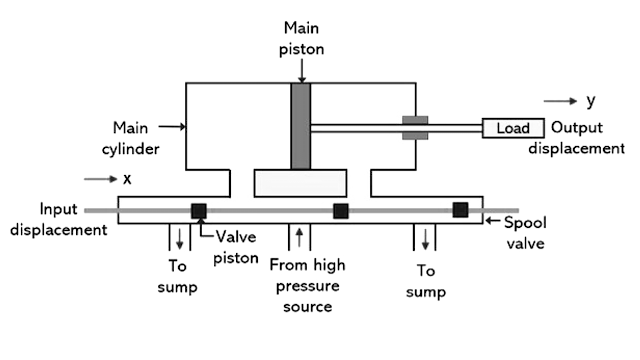
  Working of Hydraulic Actuator The figure below represents the schematic representation of the hydraulic actuator. The major component of the unit is pilot valve also known as spool valve and main cylinder (or power cylinder). It operates in a way that difference in pressure created at the two regions of the main cylinder leads to the occurrence of translational motion of the piston. Let us see the functioning of the hydraulic linear actuator is main cylinder has two regions. These two regions are obtained by dividing the main cylinder with a main piston. Thus, there are two chambers of the main cylinder. The rate with which the fluid flows inside the cylinder is controlled by the spool valve. The spool valve has 4 ports and each port is connected to a different part of the system. Two separate ports are connected to the fluid supply and drain region respectively. While the other two ports are connected separately to the two chambers of the main cylinder. Initially, the spool is p...

Ultrasonic Flow Meter Working Animation

Image
Ultrasonic Flow Meter Working Animation

Level Measurement Multiple Choice Questions

  Level Measurement Multiple Choice Questions 1. Which of the following devices are used for a level to force conversion? a) Load cell b) Membrane c) Diaphragm d) Voltmeter Answer: Load cell 2. If the specific gravity of the liquid inside the vessel increases, what aspects of the transmitter’s calibration will we need to change in order to maintain accurate liquid level measurement? a) We will need to change the transmitter’s LRV and linearity b) We will need to change the transmitter’s linearity and span c) We will need to change the transmitter’s LRV and URV d) We will need to change the transmitter’s linearity and zero Answer : We will need to change the transmitter’s LRV and URV 3. Suppose a storage vessel holds a liquid of unpredictable density. Identify which level measurement technology will not maintain accurate measurement of liquid height in the vessel as the liquid density changes a) Differential pressure transmitter b) Guided-wave radar c) Ultrasonic d) Float and tape A...

Flow Measurement Objective Type Questions and Answers

  Flow Measurement Objective Type Questions and Answers 1. For accurate operation, orifice plate flowmeters require a) Laminar flow b) Fully-developed turbulent flow c) Swirls and eddies in the flow stream d) Transitional flow Answer : Fully-developed turbulent flow 2. A flag flapping in the breeze illustrates what type of dynamic fluid effect? a) Cavitation b) Vortex shedding c) Transitional flow d) Coriolis effect Answer : Vortex shedding 3. A ∆P transmitter calibrated for a range of 0 to 100 ”H2O measures liquid flow through an orifice plate from 0 to 1200 GPH. Calculate the new calibration range for the transmitter if we desire to decrease the flow measurement range to 0 to 700 GPH, using the same orifice plate. a) 0 to 34.03” H2O b) 0 to 76.38” H2O c) 0 to 171.4” H2O d) 0 to 293.9” H2O Answer : 0 to 34.03” H2O 4. Identify which of the following flowmeters inherently measures mass flow rate a) Thermal b) Magnetic c) Flow nozzle d) Vortex Answer : Thermal 5. As an incompressible...

Pressure Regulators Multiple Choice Questions

  Pressure Regulators Multiple Choice Questions 1. The measuring element _______________ a) Measures the inlet flow b) Measures the outlet flow c) Compares the inlet flow to the outlet flow d) None of the above Answer: Compares the inlet flow to the outlet flow 2. A pressure regulator includes? a) restricting element b) loading element c) measuring element d) All of the above Answer: All of the above 3. Regulators are used for? a) Gases b) Liquid c) Solid d) Both a and b Answer: Both a and b 4. _____________ regulators are two regulators in series in the same housing that operate to reduce the pressure progressively in two steps instead of one. a) One stage b) Two stage c) Three stage d) Four stage Answer: Two stage 5. Restricting element in a pressure regulator can be _________ a) Globe valve b) Poppet valve c) Butterfly valve d) All of the above Answer: All of the above 6. In pressure regulators load flow is ___________ proportional to regulator flow a) depends b) indirectly...

Control Loops Multiple Choice Questions

  Control Loops Multiple Choice Questions 1. The most common analog signal standard for industrial process instruments is 4 to 20 _________ a) milliamps DC b) amps AC c) volts d) milliamps Answer: milliamps DC 2. Which of the following is not a “final control element”? a) A pressure transmitter b) An electric motor c) A heating element d) A control valve Answer : A pressure transmitter 3. Identify which of the following is an example of a “primary sensing element”  a) I/P transducer b) Instrument signal cable c) Control valve d) Diaphragm Answer : Diaphragm 4. A basic control loop will consist of __________ a) signal converter, resistor, knob, and control valve b) transducer, valve packing, hex-head wrench, and tubing c) transmitter, controller, I/P transducer, and control valve d) resistor, capacitor, terminal block, and battery Answer : transmitter, controller, I/P transducer, and control valve 6. The purpose of a “shield” wire on an instrument signal cable is to __________ ...

Dynamic behaviour of first order and second order systems Objective Questions and Answers

  Dynamic behaviour of first order and second order systems Objective Questions and Answers 1. In a second order system, the damping factor is 0.65 and the natural frequency is 4 Hz. If the stiffness of springs is halved, the new values of damping factor and natural frequency are _______ a) 0.92, 2.83 Hz b) 0.46, 5.66 Hz c) 0 92, 5.66 Hz d) 0.46, 2.83 Hz. Answer: 0.92, 2.83 Hz 2. The volume of bulb of a liquid filled thermometer is 1000 mm3. Its time constant and sensitivity are respectively 300 s and 3.6 mm/°C. If the volume of the bulb is reduced to 500 mm3, the sensitivity becomes ______________ a) 7.2 mm/°C b) 10.8 mm/°C c) 1.8 mm/°C d) 1.2 mm/°C if other conditions remain the same. Answer: 1.8 mm/°C 3. In force-current analogy stiffness constant K is analogous to __________ a) inductance b) reciprocal of inductance c) capacitance d) reciprocal of capacitance Answer: reciprocal of inductance 4. Dynamic response consists of __________ a) two parts, one steady state and the other...

Pole- Zero effect on process response Objective Questions and Answers

  Pole- Zero effect on process response Objective Questions and Answers 1. Pressure error can be measured by which of the following? a) Differential bellows and strain gauge b) Selsyn c) Strain gauge d) Strain gauge and potentiometer Answer: Differential bellows and strain gauge 2. Zeroes are defined as _______ a) Roots of the denominator of the closed loop transfer function b) Roots of the numerator of the closed loop transfer function c) Parts of the numerator d) Parts of the denominator Answer: Roots of the numerator of the closed loop transfer function 3. Addition of __________  increases the stability. a) zero b) one  c) number d) none of the mentioned Answer: zero 4. _____________ is not a final control element. a) Control valve b) Potentiometer c) Electro-pneumatic converter d) Servomotor Answer: Potentiometer 5. A control system is generally met with the time response specifications  _____________ a) Steady state accuracy b) Damping factor c) Setting time d) ...

Approximation of higher order models Objective Questions and Answers

  Approximation of higher order models  Objective Questions and Answers 1. The second derivative input signals modify which of the following? a) The time constant of the system b) Damping of the system c) The gain of the system d) The time constant and suppress the oscillations Answer: The time constant and suppress the oscillations 2. Which of the following statements is correct for a system with gain margin close to unity or a phase margin close to zero? a) The system is relatively stable b) The system is highly stable c) The system is highly oscillatory d) The system is stable Answer: The system is highly oscillatory 3. Zero initial condition for a system means? a) Input reference signal is zero b) Zero stored energy c) Initial movement of moving parts d) System is at rest and no energy is stored in any of its components Answer: System is at rest and no energy is stored in any of its components 4. On which of the following factors does the sensitivity of a closed loop syste...