Posts

Questions And Answers On Industrial Internet Of Things

Questions And Answers On Industrial Internet Of Things 1. ___ is a subset of machine learning that can learn automatically by finding the features of the object on its own. a) Deep learning b) Artificial intelligence c) Human learning d) None of the above Answer: Deep learning 2. SQL stands for_____ a) Structured Query Language b) Semantic Query Language c) Source Query Language d) Safe Query Language Answer: Structured Query Language 3. Which of the following is not a characteristic of Big Data ? a) Velocity b) Veracity c) Vitality d) Value Answer: Vitality 4. HDFS is a file system derived from open-source codes of ____. a) Smart FS b) KFS c) GFS d) None of the above Answer: GFS 5. Which of the following feature(s) is/are essential for cloud-based analytics methods as per NIST? a) Wide network access b) Method grouping c) Fast flexibility d) All of the above Answer: All of the above 6. Which of the following is/are the component(s) of Cyber Security? a) Application security b) Informa...

Need of automated industry

Need of automated industry Automation in the industrial workplace provides the advantages of improving productivity and quality while reducing errors and waste, increasing safety, and adding flexibility to the manufacturing process. Industrial automation yields increased safety, reliability, and profitability. These systems make automation possible for factories and industrial processes, allowing a continuous mass production 24/7. 24 hours a day, seven days a week, which improves productivity and reduces assembly times By means of adaptive control and monitoring in different stages and industrial processes, these systems are useful in eliminating human error and thus improve the quality and homogeneity of the products offered. The performance is not reduced after several hours of continuous work Improved worker safety Automated cells remove workers from dangerous tasks. Your employees will thank you for safeguarding them against the hazards of a factory environment. Increased productio...

Industrial Automation Tools

Industrial Automation Tools Industrial Automation Tools are the technologies that control and manage systems and devices. Moreover, these tools reduce the possibility of human errors, decrease costs, save time, etc.  Different types of automation tools used in industry DCS :  Monitoring networks PLC : Multiple input and output arrangement SCADA : Find new ways to operate faster HMI : Helps to Control industrial automation equipment ANN : Responsible in processing information Robotics DCS DCS stands for Distributed Control System. Distributed Control System is one of the most popular industrial automation tools. It also caters to multiple processes in the manufacturing industry. Moreover, it contains one or more controller components distributed in the system. PLC PLC stands for Programmable Logic Controller. A Programmable Logic Controller or PLC is a robust digital industrial computer control system. It is preprogrammed to execute automatic operations in the manufacturing ...

Basic Control Strategies Used in Industrial Control System

Basic Control Strategies Used in Industrial Control System How well the process parameters are controlled depends on the control strategy implemented for that process. Basic control strategies used in most of the industries are ON – OFF Control Open-Loop Control Feed- Forward Control Closed-Loop control ON – OFF Control It is also called as two- position control system that has only two states fully on and fully off. It is the oldest type of control strategy that gives simple on- off mechanism for the set limits. When the process variable (PV) or measurement is below the set limit, then the controller is switched ON and the manipulated variable (MV) changes to maximum value. Similarly, if the PV is above the set limit, then the controller gets turned OFF and the MV changes to minimum value. Open-Loop Control In this control structure, control action is not a function of process variable or any load changes. This is also not a self-correcting one. This control scheme independently calcu...

Automation pyramid

Image
Automation pyramid Levels of Automation Pyramid Level 0:   Field Level/Production Process Level 1:  Control Level/Sensing and Manipulation Level 2:  Supervisory Level/Monitoring and supervising Level 3:  Planning Level/Operations Management Level 4:  Enterprise Level(Business Planning and Logistics) Level 5:  Cloud Level 0: Field Level/Production Process This level has devices, actuators, and sensors that are found in the field or on the production floor. The field level is the production floor where physical work and monitoring happens. Electric motors, hydraulic and pneumatic actuators to move  machinery, proximity switches to detect movement of certain materials,  photoelectric switches that detect similar things are some examples at the field  level. Level 1: Control Level/Sensing and Manipulation PLC’s and PID’s operate at this level. At this level, you control and manipulate the devices in the field level that actually do the physi...

Cascade control strategy used for control of temperature in an exothermic chemical reactor

Image
Cascade control strategy used for control of temperature in an exothermic chemical reactor

Steam Pressure Control in Boiler

Steam Pressure Control in Boiler Steam pressure is the key variable that indicates the state of balance between the supply and demand for steam. If supply exceeds demand, the pressure will rise. Conversely, if demand exceeds supply, the pressure will fall. Plants may experience fluctuations in demand due to batch processes or other process changes. In this case, a steam flow feedforward signal is used with steam pressure control. The term Plant Master is most applicable to the situation in which more than one boiler supplies a common steam header. In this case, there are multiple boiler masters but only one plant master. The plant master generates the master firing rate demand signal that drives the individual boilers in parallel. With multiple boilers, the Plant Master is typically configured with a variable gain, based on the number of boilers in automatic mode. 

Shrink and Swell effect in boiler

Shrink and Swell effect in boiler Shrink  effect  Now as the steam pressure starts increasing steadily the boiler pressure increases and boiling point of water also starts increasing which lead to decrease in bubble formation and level starts dropping and water level seems decreasing. Now automatic water level control valve opens and cool water enters the system and bubbles burst leading to decrease in level of water more. This effect is called shrinkage. Swell effect  Let us suppose discharging of cargo in a tanker is going on. Now due to sudden increase in steam demand due to starting of another copt or due to sudden increase in rpm of copt’s there is a sudden drop in boiler pressure. This sudden drop in pressure leads to vapourization of water as boiling point of water decreases with decrease in pressure. Hence the formation of bubbles inside the boiler makes the level of water looks like increased which in real in not there. This phenomenon is known as swelling which ...

Air and Fuel Ratio Control

Image
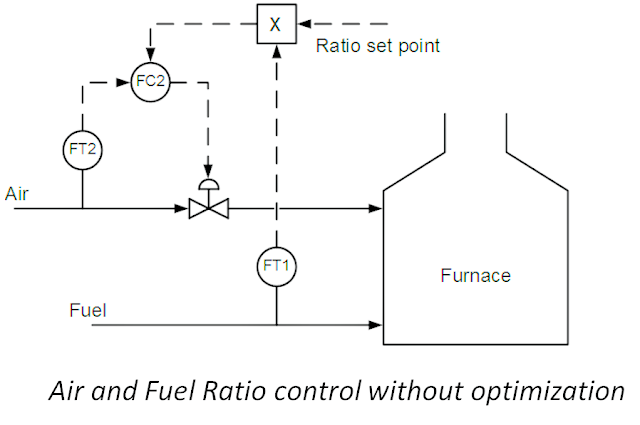
Air and Fuel Ratio Control In Combustion processes, air/fuel ratio is normally expressed on a mass basis. We get maximum useful heat energy if we provide air to the combustion zone at a mass flow rate (e.g. ib/min, kg/hr) that is properly matched to the mass flow rate of fuel to the burner. Air and fuel ratio control Consider this generic equation for fuel combustion chemistry: Fuel + Air =Useful heat + CO2 + H2O + CO + Unburned Fuel + Waste Heat Up the Stack ( CO + Unburned Fuel ) Increases as combustion air Decreases  ( Waste Heat Up the Stack ) Increases as combustion air Increases  Where CO2 = Carbon dioxide  CO = Carbon monoxide  H2O = Water  Air = 21% oxygen (O2) and 79% nitrogen (N2)  Fuel = Hydrocarbon such as natural gas or liquid fuel oil  Normally Air/Fuel ratio control is known as series control This means the change in air flow rate occurs as per ratio set only after the change has occurred in fuel flow rate. But in boilers used in power p...

Burner Management System

Image
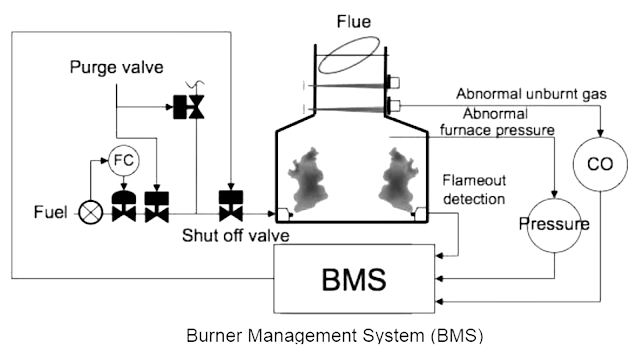
Burner Management System  A burner management system(BMS) is a safety solution that manages a combustion system and is responsible for Start-up and main flame detection Control and monitoring  Shutdown sequences  The BMS is considered a safety instrumented system (SIS). In  PLC technology is used, it is often based on 1oo2 (one-out-of-two) or 2oo3d (two-out-of-three diagnostics) logic BMS interlocks must be implemented with dedicated systems. It can be accomplished by hard-wired relay logic, solid-state logic, or PLCs. Burner management systems are engineered to provide igniters (pilot) and main flame detection, as well as control and monitoring of burner start-up and shutdown sequences. This systems can help protect people, combustion process equipment, and surroundings areas in the event of an explosion or hazardous incident. BMS includes alarm management and operator display. These features help simplify unit operation while reducing start-up time. Purpose of BMS ...

Start-up procedure of boiler

Start-up procedure of boiler Power the burner switch and prove the pilot and main flames. Check to see that the boiler vent and drain between the main stop valve(s) and the non-return valve are open. This is done to bleed any air from the system. If installed, open the equalizing valve around the main steam-stop valves. Open the main steam-stop valve(s). When the pressure reaches 10 to 15 psig, close the boiler vent. Test the low-water cutoff by securing the boiler feed and let the boiler steam off naturally to see if the switch cuts power to the burner at the proper low level. If it does not, break power to the burner immediately and take corrective action. With a positive result, reopen the boiler feed valve. Open the non-return valve when the steam pressure reaches 75 to 85 percent of the system-line pressure. Manually test the safety valve for proper operation and reseating. Bring up the boiler pressure slowly during low fire, allowing the non-return valve to automatically cut the ...

Excess air optimization

Excess air optimization If combustion air supply is in deficient, proper combustion of fuel may not take place and  hence loss due to unburned fuel will be more.  If combustion air supply is in excess, loss due to unburned fuel is negligible; whereas  heat loss due to heat energy carried away be flue gas will increase.  Furnace losses are mainly divided into three parts.  Loss due to unburned fuel or incomplete combustion loss  Loss due to heat energy carried away by flue gases or flue gas loss  Loss due to radiation and wall losses  Incomplete combustion loss   When air deficiency is there, the fuel atoms do not find enough oxygen atoms to  get burned.  Then some combustibles are left unburned.  This unburned fuel quantity gets reduced when enough or excess combustion air  is supplied.  The loss due to incomplete combustion will be almost negligible in the excess air  region.  Flue gas loss  The heat l...

Boiler control

Boiler control Boiler control used  Increase uptime and availability The primary objective of most boiler operations is maintaining availability, or uptime. Many facilities have more than one boiler on-site running in parallel. It is essential to maintain and upgrade the boiler control systems to assure steam availability. Modern controls are more reliable and can readily adjust to load swings caused by varying overall plant operations.  Reduce flue gas emissions Failure to comply with current emissions regulations can be as costly as lost utilities. Government mandates enforced by fines, threat of closure, or imprisonment will usually provide sufficient incentive to comply with the regulations and modernize controls if necessary. Improved combustion efficiency reduces unwanted combustion by-products. Anything that goes into the manufacture of a product (raw materials, fuel, air, water, etc.) that is not in the final product is wasted cost. This can also create added waste dis...