Posts

What is a controller?

What is a Controller ? A Controller is the core part of an industrial automation system that manages, regulates, and stabilizes process parameters such as pressure, temperature, flow, and level. It works like the brain of automation — receiving signals from field sensors, processing data, and sending commands to actuators or control devices to maintain the desired process conditions. How Does a Controller Work? A controller operates on a closed-loop control principle , continuously comparing the measured process value with a predefined setpoint. If any difference (error) is detected, the controller automatically corrects it by adjusting the output signal to actuators, valves, or motors. Measurement: Sensors measure process parameters and send electrical signals (4–20 mA or 0–10 V) to the controller. Comparison: The controller compares the measured value with the desired setpoint to find the error. Correction: Based on control logic (P, PI, or PID), it sends an output si...

What is a Controller in Automation?

Image
What is a Controller in Automation? A Controller is one of the most essential components in an industrial automation system . It acts as the brain of the control process, responsible for analyzing, processing, and managing signals received from various field instruments and sensors. Controllers ensure that all process parameters—such as temperature, pressure, flow, and level—remain within the desired operating range by continuously monitoring and adjusting system operations in real-time, based on pre defined controller programing. Role of a Controller The main function of a controller is to process input signals from sensors and transmit appropriate output signals to actuators or control elements. These control elements, such as valves, motors, electrical instrument and dampers, perform physical actions to correct any deviation from the required setpoint. In simple terms, a controller makes decisions based on the information it receives and ensures the system operates effi...

Industrial Automation Instrumentation | Process Control Instruments

Industrial Automation Instrumentation | Process Control Instruments Complete guide to mechanical, pneumatic, and electrical instruments used to control flow, pressure, temperature, and level — and how they integrate with PLC and DCS systems. In industrial automation systems, various mechanical instruments such as ball valves, butterfly valves, piston valves, gate valves, and non-return valves (NRV) etc. are widely used to control the process flow, temperature, and pressure according to operational requirements. These mechanical instruments play a crucial role in maintaining process stability and reliability. Depending on the process design and system requirements, industries select standard or custom-modified instruments to achieve precise control and safety. To improve monitoring, control accuracy, and remote supervision, industries are now adopting pneumatic and electrical instruments. These modern instruments can communicate seamlessly with industrial computers, PLCs ...

What is an Instrumentation Cable?

What is an Instrumentation Cable? Instrumentation cables are designed to carry low-power, low-current signals between field instruments and control systems. They are specially constructed to minimize electrical noise and ensure accurate signal transmission even in harsh industrial environments. Key Features Shielding: Reduces EMI and RFI interference. Twisted pairs: Minimize crosstalk between adjacent signals. Durability: Resistant to temperature, chemicals, and mechanical stress. Flame retardant options: Improve safety and compliance with standards. Typical Applications Process automation and control systems Transmitter (4–20 mA) and sensor connections Monitoring and data acquisition systems Types of Instrumentation Cables Unarmoured Cable: For indoor or protected installation. Armoured Cable: For mechanical protection in outdoor or hazardous areas. Shielded Cable: With individual and overall ...

Programmable Logic Controllers

Image
Programmable Logic Controllers (PLC) Overview, Architecture, and Applications What is a Programmable Logic Controller (PLC)? A Programmable Logic Controller (PLC) is an industrial digital computer used to control machinery and automation processes. It monitors input signals from field devices, processes them through programmed logic, and produces control outputs to actuators, relays, or motors. PLCs are available in various sizes such as Nano, Micro, Medium, and Large PLCs . A Nano PLC may handle around 100 I/O modules, while a Large PLC can manage more than 5000 I/O modules. Also PLCs are available in compact type and modular type and compact type PLC has fixed size I/O and all the modules included basically compact type PLC does not increase the number of I/O modules but modular PLC has modified these I/O modules as required. A PLC has a separate module and is placed in a rack or box type. Commonly PLC with...

Difference Between PLC and PAC | Complete Guide

Difference Between PLC and PAC | Complete Guide In modern industrial automation , both PLCs (Programmable Logic Controllers) and PACs (Programmable Automation Controllers) are used to control and monitor machinery, processes, and systems. Although they perform similar functions, their architecture, processing power, and integration capabilities make them suitable for different applications. 🔹 What is a PLC? A Programmable Logic Controller (PLC) is a rugged, real-time industrial computer used to execute control logic in manufacturing and process automation. It reads inputs from sensors, executes ladder logic, and sends outputs to actuators like relays, motors, or valves. Designed for deterministic control (fast I/O response) Best for discrete control (Start/Stop, sequencing, interlocks) Simple programming using Ladder Logic (LD) Highly reliable and suited for harsh industrial environments 🔹 What is a PAC? A Programmable Automati...

What is Schneider PLC? | Complete Guide for Beginners

What is Schneider PLC? | Complete Guide for Beginners Schneider PLC refers to Programmable Logic Controllers manufactured by Schneider Electric , a global leader in industrial automation and energy management. These PLCs are widely used to automate machines, processes, and control systems across various industries. About Schneider Electric PLC Schneider Electric offers a range of PLCs under the Modicon family, known for reliability, scalability, and Industrial IoT integration. These PLCs are designed for everything from small machine control to large process automation. 🧩 Main Schneider PLC Series PLC Series Application Area Software Used Key Features Modicon M221 Small machines EcoStruxure Machine Expert – Basic Compact design, Modbus & Ethernet support Modicon M241 / M251 Medium-scale automation EcoStruxure...

How to Setup VFD (Variable Frequency Drive)

 How to Setup VFD (Variable Frequency Drive) A Variable Frequency Drive (VFD) is used to control the speed and torque of an AC motor by varying the frequency and voltage supplied to the motor. Proper setup ensures efficient performance, protection, and smooth operation of your motor and system.  Required Tools & Equipment Multimeter (for voltage, current, and continuity checks) Insulation tester (Megger) – for motor insulation check Screwdrivers, wire strippers, and crimping tools Motor nameplate data Manufacturer’s VFD manual Step-by-Step VFD Setup Procedure 1️⃣ Pre-Installation Check Verify motor rating (kW/HP, voltage, current, frequency) matches VFD output rating. Check supply voltage matches VFD input rating. Ensure grounding/earthing continuity. Test motor insulation (should be above 1 MΩ). 2️⃣ Power & Motor Wiring Connection Symbol Description R / L1 Input AC Supply Phase 1 S / L2 Input AC Supply Phase 2 ...

How to Calibrate a Pressure Transmitter — Step-by-Step Guide

How to Calibrate a Pressure Transmitter — Step-by-Step Guide Pressure transmitter calibration ensures that the transmitter provides accurate readings of applied pressure by comparing it with a known reference standard. This is essential for process accuracy, safety, and reliability. Required Equipment Pressure Calibrator / Hand Pump / Dead Weight Tester – for applying known pressure. Digital Reference Gauge – for precise measurement accuracy. 24 V DC Power Supply – to power the transmitter. Multimeter / Loop Calibrator – to measure 4–20 mA output signal. HART Communicator – for SMART transmitters. Tubing and Fittings – for proper connection and sealing. Working Principle A pressure transmitter converts the applied pressure into a proportional electrical signal (4–20 mA) . Typically, 4 mA represents 0% (LRV) and 20 mA represents 100% (URV) of the calibrated pressure range. Calibration Procedure Step 1: Isolate ...

Vortex Flow Meter working principle and applications

Image
 Vortex Flow Meter A Vortex Flow Meter utilizes a bluff body or cylinder mounted in a pipe spool that creates alternating vortices behind it. The frequency of these vortices is directly proportional to the fluid velocity. These flow meters have no moving parts , minimal maintenance, and are highly reliable for clean fluids. The vortex signal is electronically processed to determine flow rate.  Vortex meters work well with most clean fluids and have similar application ranges to DP flow meters. ⚙️ Working Principle As fluid passes around a bluff body, vortices are alternately formed on either side. The rate of vortex formation is proportional to the fluid’s velocity. Sensors detect these pressure fluctuations and convert them into electrical pulses proportional to flow rate. This principle is known as the vortex shedding principle .  Vortex flow meters utilize  a bluff body or cylinder mounted in a pipe spool that creates alternating vo...

Flow Meter

Image
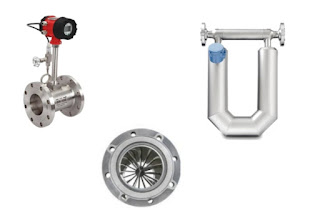
Flow and Flow Meters A flow meter is an instrument used to measure the rate or quantity of a fluid (liquid, gas or steam) moving through a pipe or open channel. Accurate flow measurement is essential for process control, custody transfer, energy management and plant safety. 1. What is Flow? Flow is the amount of fluid passing through a cross-sectional area per unit time. Mathematically: Q = V × A Q = flow rate, V = velocity, A = cross-sectional area Units: L/min, m³/h, m³/s, kg/s, ton/h, GPM (gallon/min) 2. What is a Flow Meter? A flow meter (or flow sensor) measures volume, mass or velocity of a fluid and converts it to a readable output (analog or digital). Flow meters are used across industries such as water & wastewater, oil & gas, chemical, power, food & beverage and pharmaceuticals. 3. Flow Measurement Components Primary element — produces a measurable change (pressure drop, velocity profile, etc.). Examples: orifice plate, ...

Flow switch

Image
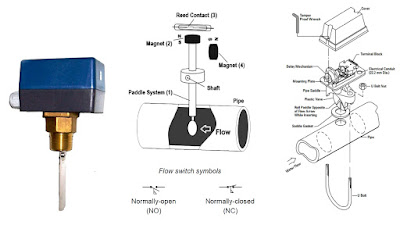
Flow Switch – Working, Types, and Applications A Flow Switch is a mechanical or electrical device that monitors the flow of air, liquid, or steam in a system. It helps detect whether flow is within the desired range and sends an electrical signal to control devices such as pumps, alarms, or safety interlocks. Flow switches play a crucial role in preventing equipment damage caused by loss of flow, overheating, or dry running. They are commonly used in water treatment systems, chillers, fire protection, and HVAC systems. ⚙️ Working Principle The flow of fluid pushes a paddle or sensor element inside the pipe. This movement changes the position of a mechanical lever or sensor element, activating or deactivating an electrical contact. The signal is then sent to a control system, pump, or alarm circuit. Construction & typical components Standard flow switches usually include: Body / housing (material matched to fluid) Sensing element (padd...